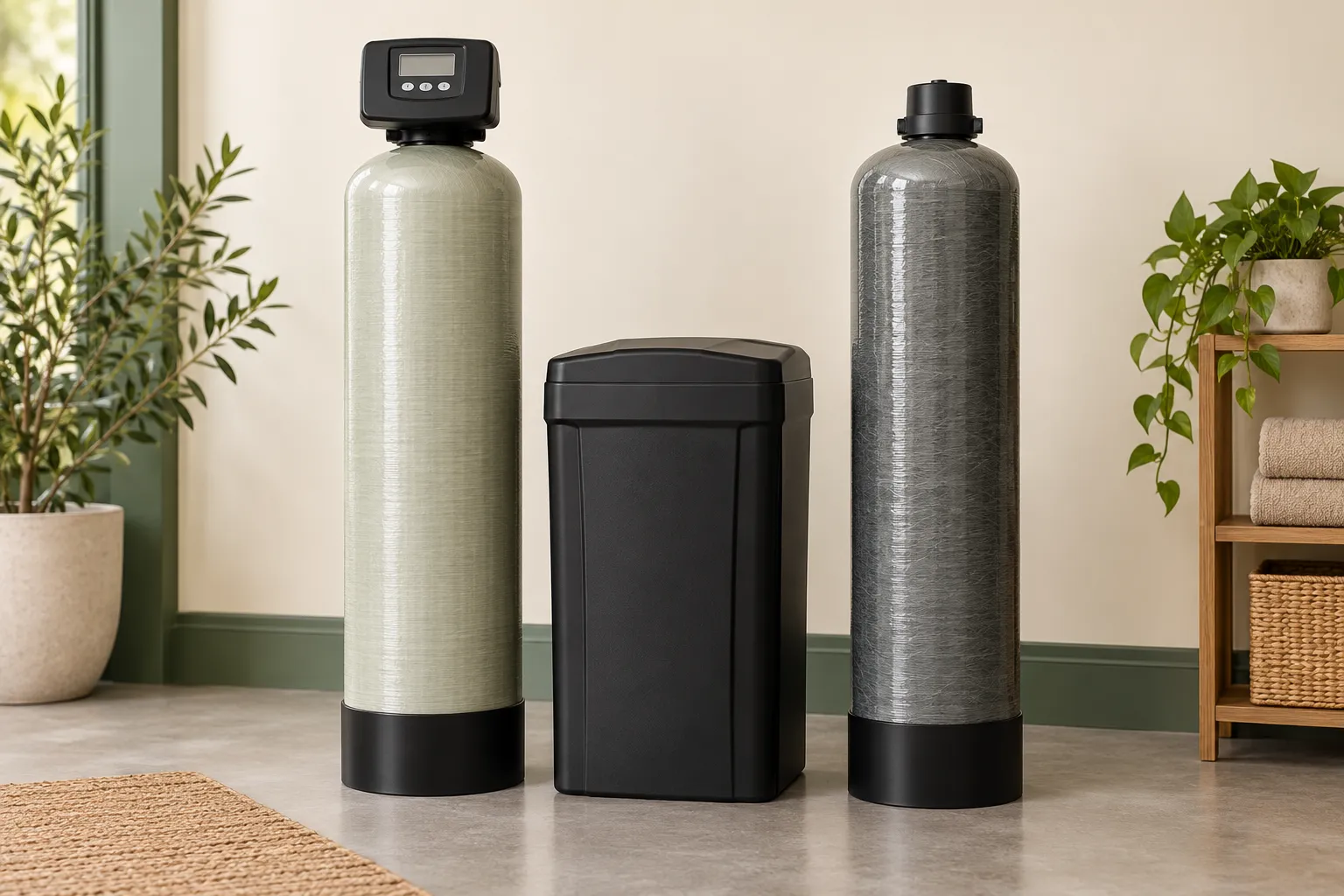
Highlands Ranch Water publishes its own number: 11 to 13 grains per gallon (188–222 mg/L), and the district does not remove that hardness before it reaches your tap. A correctly sized softener is the only fix that addresses it at the source — here's how sizing, system types, installation, and cost actually work for a Highlands Ranch home.
If you've moved to Highlands Ranch from somewhere with softer water, the signs show up fast: white crust ringing the faucets, a shower door that never wipes fully clear, coffee that tastes faintly different, and skin that feels dry no matter how much lotion you use. None of that is your imagination and none of it is a plumbing defect. It's simple water chemistry. Highlands Ranch Water's own published data puts the district's hardness at 11 to 13 grains per gallon (188–222 mg/L) — solidly in the "hard" to "very hard" range — and the utility is upfront that it does not soften the water during treatment, because hardness isn't a safety issue the way bacteria or lead would be. The water leaving the treatment plant meets every EPA and CDPHE requirement. What it doesn't do is spare your fixtures, your appliances, or your glass.
That's where a home water softener comes in. It's not a substitute for anything the district does — it's a separate, additional step that homeowners choose to take because 11–13 grains per gallon is genuinely hard on a home over time. Below is a plain-language walkthrough of how softening actually works, how to size a system correctly for your household, what the real installation and cost picture looks like, and what to expect for upkeep.
Every conventional water softener sold for residential use — regardless of brand or control valve — relies on the same chemistry: ion exchange. Water passes through a tank filled with thousands of small resin beads coated in sodium (or potassium) ions. As hard water flows through the resin bed, calcium and magnesium ions — the minerals responsible for hardness — are attracted to the resin and swap places with the sodium or potassium ions sitting on the beads. The water that comes out the other side has had its calcium and magnesium exchanged out, which is the literal definition of "soft."
Over time, the resin bed fills up with captured calcium and magnesium and needs to be "regenerated" — flushed with a concentrated brine solution from the connected salt (or potassium chloride) tank, which strips the resin clean and washes the hardness minerals down the drain, resetting the resin to full capacity. That regeneration cycle is what the brine tank and the control valve's timer or sensor are managing behind the scenes. It's also the step that determines how much salt and water a softener actually uses over a year, which is where system type and controller quality start to matter.
Softener capacity is measured in grains — the total hardness a resin tank can remove before it needs to regenerate. Getting the size right matters more here than in a soft-water market, because undersizing means constant regeneration cycles that burn through salt and shorten resin life, while oversizing wastes money on a system doing far less work than it's built for.
The sizing math starts with your household's daily grain load:
Number of people × 75–100 gallons per person per day × water hardness in grains per gallon (11–13 in Highlands Ranch) = daily grain load
A single person using 80 gallons a day on 12-grain water generates roughly 960 grains of hardness daily. A family of five doing the same math is closer to 6,000 grains a day. Softener capacity is then sized so the system regenerates on a reasonable cycle — most installers target regeneration every 3 to 7 days rather than daily, which is both more efficient and less wearing on the resin and valve.
| Household size | Approx. daily grain load | Typical softener size |
|---|---|---|
| 1–2 people | ~1,300–2,100 grains | 24,000 grain |
| 3–4 people | ~2,600–5,200 grains | 32,000 grain |
| 5–6 people | ~4,400–7,800 grains | 40,000–48,000 grain |
| 6+ people, or large lots with irrigation tie-ins | 7,000+ grains | 48,000–64,000 grain, sometimes dual-tank |
Two things push Highlands Ranch sizing higher than a generic national estimate: the hardness itself sits at the upper end of most softener manufacturers' standard charts, and larger newer-construction homes in villages like Backcountry and Eastridge often carry higher fixture counts, multiple bathrooms, and irrigation systems that all pull from the same softened line unless it's specifically excluded. A free in-home water test accounts for your household's actual usage and confirms exactly where your water falls in the 11–13 range that day, since Highlands Ranch Water occasionally supplements the South Platte River supply with groundwater, which can shift hardness slightly during dry stretches.
Our softener sizing calculator runs this same math live — plug in your household size and hardness for an instant size and cost estimate.
| System type | How it works | Best for |
|---|---|---|
| Single-tank, timer-based | Regenerates on a fixed schedule regardless of actual usage | Lower upfront cost; less efficient on salt and water use |
| Single-tank, demand-initiated (metered) | Regenerates based on actual water use measured by a flow meter | Most homes — cuts salt and water use substantially versus a timer |
| Dual-tank | A second resin tank takes over automatically while the first regenerates | Larger households or homes that never want a soft-water gap during regeneration |
| Salt-free conditioner | Alters mineral crystal structure to reduce scale adhesion; does not remove hardness | Renters or homes barred from salt discharge — not a full fix at 11–13 GPG |
For most Highlands Ranch households, a demand-initiated (metered) single-tank system is the practical middle ground: it only regenerates when the resin bed is actually depleted, which at this hardness level noticeably cuts salt bags and water used per year compared with an old-style timer unit. Dual-tank systems make sense for larger households, home offices with heavy daytime water use, or anyone who wants zero risk of hitting a regeneration cycle mid-shower. Salt-free conditioners are worth understanding but shouldn't be marketed as a softener replacement at this hardness — they change how scale behaves, they don't remove the minerals causing it, so spotting on glass and fixtures typically continues.
A typical softener installation in a Highlands Ranch home takes a local specialist a few hours to half a day, and follows roughly the same sequence regardless of system brand:
Because Highlands Ranch is largely HOA-governed through the Highlands Ranch Community Association and individual sub-associations, it's worth confirming any exterior equipment placement or drain modification against your specific covenant guidelines before installation day — most softener installs are entirely interior and don't require exterior approval, but larger utility-room reconfigurations occasionally do.
Pricing varies with system size, valve technology, water pressure requirements, and whether the install includes extras like a dedicated bypass loop or a separate drinking-water tap. As a general range for Highlands Ranch homes:
Roughly $1,800–$4,500 installed for a properly sized single-tank metered softener in a standard residential setup. Larger dual-tank systems or installs requiring significant plumbing rework run higher. A free water test and in-home consultation is the only way to get a number specific to your house rather than a national average.
Ongoing costs are modest: a bag of softener salt runs roughly $6–$10 and, depending on household size and system efficiency, most homes go through one to three bags a month. Potassium chloride, an option for households limiting sodium intake, costs meaningfully more per bag but works through the same resin.
A well-maintained softener is a low-effort appliance. The main ongoing task is keeping the brine tank filled with salt — most homeowners check it monthly and top it off before it runs empty, since an empty brine tank means the next regeneration cycle can't fully recharge the resin, and hard water starts slipping through. Resin beads themselves typically last 10–15 years before losing enough capacity to warrant replacement, longer with well-maintained equipment and consistent salt levels. Control valves and the softener's internal seals are the parts most likely to need service over that span, particularly on older timer-based units running more regeneration cycles than a metered system would.
Crusty mineral deposits around faucet aerators, showerheads, and the coffee maker's water line.
Frameless glass shower enclosures developing a permanent hazy film despite regular cleaning.
Matte black and brushed-gold hardware showing spotting and dulling faster than expected.
Soap not lathering fully and skin feeling tight or itchy after showering.
Water heaters, dishwashers, and washing machines needing service or replacement earlier than expected.
Dishwasher-clean dishes coming out with visible mineral spots even with rinse aid.
See how softening compares with whole-house filtration, what a free water test actually measures, and the full breakdown of Highlands Ranch's water quality data.
A free in-home water test gives you your exact hardness number and an honest sizing recommendation — no pressure, no guesswork.
Get My Free Water Test