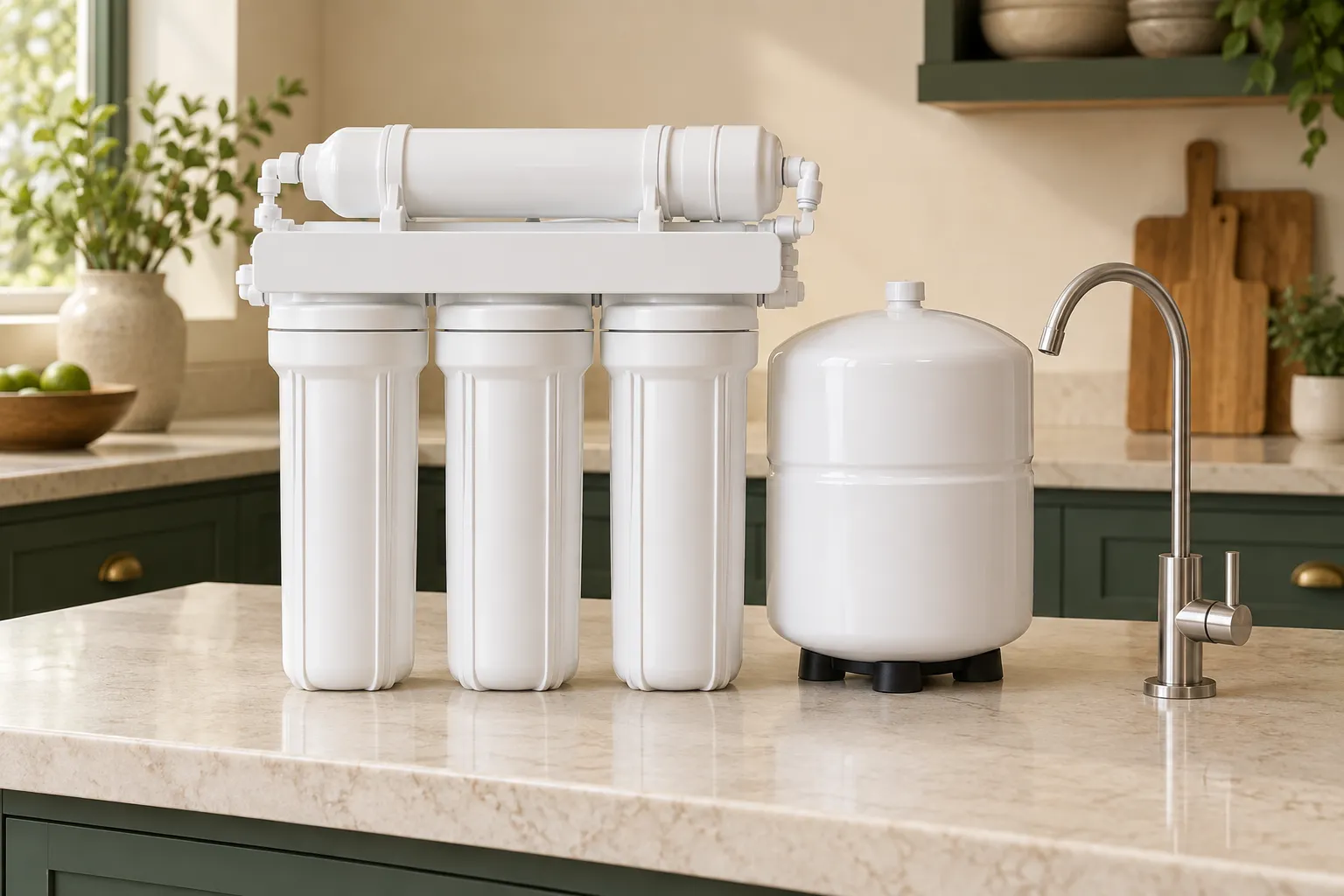
Highlands Ranch's tap water meets every EPA and CDPHE requirement as delivered — this isn't a safety upgrade. It's a taste and quality upgrade: a dedicated under-sink system that goes well beyond whole-house filtration for the water your family actually drinks, cooks with, and uses in coffee and ice.
A quick note before anything else: Highlands Ranch Water's supply meets or exceeds every EPA and Colorado Department of Public Health & Environment drinking water standard. Nothing on this page is about fixing an unsafe water supply, because that isn't the situation Highlands Ranch is in. Reverse osmosis (RO) is something homeowners choose for taste, clarity, and the kind of water quality that's genuinely noticeable in a cup of coffee, a glass poured straight from the tap, or ice that doesn't cloud — not because the water coming out of the wall is a health concern.
That distinction matters because it shapes what RO is actually for in a Highlands Ranch home: it's the most thorough filtration step available at the point of use, layered on top of — not instead of — whatever whole-house filtration and softening you already have.
RO systems push water through a semi-permeable membrane with pores small enough to block dissolved solids, most of what's left of the chlorine taste after whole-house filtration, and a wide range of other dissolved compounds, while letting water molecules through. What comes out the other side is water stripped down close to its molecular baseline — which is why RO water reads as noticeably "cleaner" and flatter in taste tests compared with straight tap water, even water that's already been through carbon filtration upstream.
A standard residential RO system is built in stages, typically four to six depending on the model:
| Type | How it works | Best for |
|---|---|---|
| Tank-style RO | Filters water in advance into a small pressurized storage tank under the sink, ready on demand | Most homes — reliable flow rate at the faucet without waiting on real-time filtration |
| Tankless RO | Filters water on demand using a booster pump, no storage tank required | Kitchens with limited under-sink space, or households wanting a smaller footprint |
Our whole-house filtration page covers sediment and carbon filtration for the entire home — every fixture, from showers to the washing machine. RO is a different tier of treatment applied to a single tap (or, in kitchens with a dedicated fridge/ice-maker line, two). It reduces total dissolved solids far more aggressively than carbon filtration alone, which is why RO water is the standard choice for:
A standard under-sink RO install in a Highlands Ranch kitchen typically takes two to four hours and includes:
Roughly $600–$1,800 installed for a standard four- to six-stage under-sink system, with tankless and higher-capacity systems (including a refrigerator tie-in) running toward the higher end. Whole-home RO systems, which treat all water entering the house rather than a single tap, are a larger undertaking and priced accordingly — most Highlands Ranch homes opt for point-of-use RO at the kitchen instead.
Older RO systems were known for wasting several gallons of water for every gallon of purified water produced. Modern systems with efficient membranes and permeate pumps have narrowed that ratio considerably, and it's worth asking any installer directly about a given system's waste ratio if water efficiency matters to you.
| Component | Typical replacement interval |
|---|---|
| Sediment & carbon pre-filters | Every 6–12 months |
| RO membrane | Every 2–3 years |
| Post-filter (final polishing stage) | Every 6–12 months |
| Storage tank air bladder | Occasional repressurization; tank replacement rarely needed before 8–10 years |
Most systems include a simple filter-change reminder or indicator light, and swapping cartridges is a straightforward homeowner task once shown — the membrane itself is the one component most homeowners have a local specialist handle, since it requires flushing and testing to confirm proper rejection rates afterward.
It's worth understanding the connection between the two systems, even though they're separate purchases. Feeding an RO system water that's already been softened extends the membrane's working life, because the same calcium and magnesium that scale a water heater can also foul an RO membrane over time, gradually reducing its rejection rate and flow. Homes running RO off unsoftened 11–13 grain water tend to see membrane replacement intervals shorten compared with homes feeding the RO system softened water first. It's not a requirement — RO systems are designed to handle hard water feed — but it's a meaningful factor in total cost of ownership over several years, and one most installers will walk through when scoping a system for your kitchen.
Tap water tastes flat, metallic, or simply "different" compared to bottled or filtered water.
Ice cubes from the fridge dispenser look cloudy or have a mineral taste of their own.
Frequent descaling cycles or a machine manufacturer that explicitly recommends filtered water.
Buying bottled or delivered water specifically because tap water taste is a household complaint.
See how RO fits alongside whole-house filtration and water softening, or start with a free water test to see your home's actual TDS and hardness numbers.
A free in-home water test measures your home's actual TDS and hardness — the numbers that determine what RO setup makes sense.
Get My Free Water Test