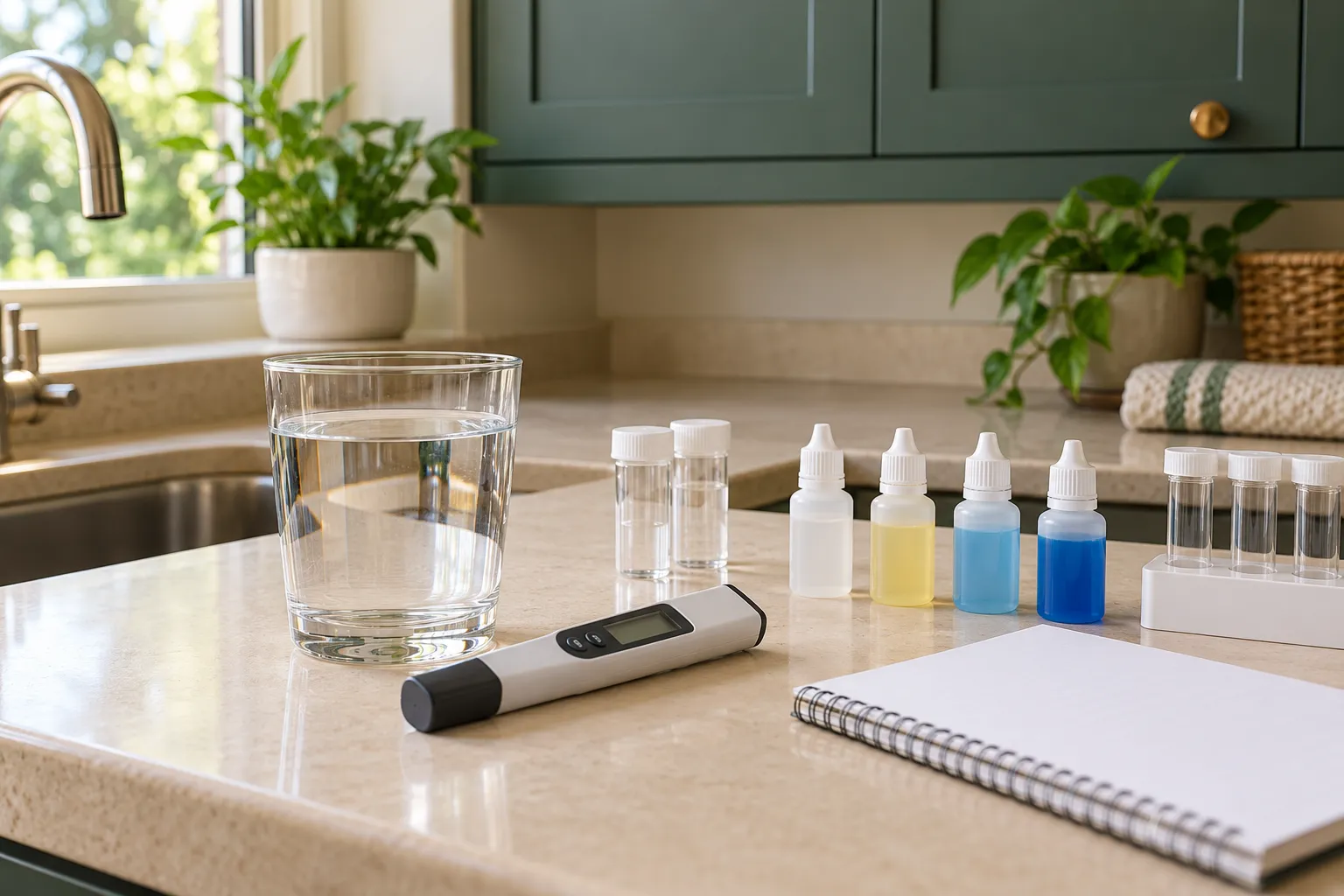
Highlands Ranch Water publishes a district-wide hardness range of 11–13 grains per gallon. Your house isn't a district average — it's one specific set of pipes, fixtures, and a specific day's water. A free in-home test tells you exactly what you're working with before anyone recommends equipment.
Every service page on this site references Highlands Ranch Water's published hardness figure — 11 to 13 grains per gallon, 188 to 222 mg/L, drawn primarily from the South Platte River. That number is accurate and it's a genuinely useful starting point. It's also, by the district's own description, a range rather than a fixed value, because Highlands Ranch Water occasionally supplements the river supply with groundwater during drought conditions or periods of peak demand, and groundwater carries a different mineral profile than surface water. A water test tells you where your home actually falls in that range on the day it's tested, rather than assuming the midpoint.
Testing also catches things a district-wide water quality report simply can't, because they happen after the water leaves the main and enters your specific plumbing.
| Measurement | What it tells you |
|---|---|
| Hardness (grains per gallon) | The exact number a softener should be sized around — confirms or refines the district's 11–13 GPG range for your specific tap |
| Total dissolved solids (TDS) | A broader measure of everything dissolved in the water, useful for deciding whether reverse osmosis makes sense at your kitchen sink |
| Free chlorine | Confirms disinfectant levels at your tap, which informs carbon filtration sizing for taste and odor |
| pH | Affects how minerals behave in your plumbing and whether certain fixture finishes are more prone to etching |
| Iron / staining (visual + strip test) | Flags reddish-brown staining risk, often more a function of aging home plumbing than the municipal supply itself |
Book a free test online or by phone — most appointments are available within a few days.
A specialist tests water directly from your kitchen tap (and, if relevant, a hose bib or secondary line) for hardness, TDS, chlorine, and pH.
Results are explained in plain language on the spot — what the numbers mean and what they don't.
If you want equipment recommendations, they're based on your actual numbers. If you don't, the test results are yours to keep either way.
Drugstore and hardware-store test strips have a place — they're a fast, inexpensive way to get a rough hardness reading, and they're genuinely useful if you just want a general sense of where your water falls. Their limitation is precision and scope: strips are typically calibrated in wide bands (for example, jumping from "150 mg/L" to "250 mg/L" with nothing in between), which isn't precise enough to size a softener correctly, and they don't measure TDS, chlorine, or pH at all. A professional in-home test uses calibrated equipment and covers all of those measurements in one visit, which is why it's the standard first step before any equipment purchase — not because strips are wrong, but because they're not detailed enough for sizing decisions.
There's no obligation attached to testing. Some homeowners test out of curiosity or because they're renovating a kitchen or bathroom and want a baseline before selecting fixtures and finishes. Others test specifically because they're seeing scale buildup, spotting, or taste changes and want to know what's actually causing it before buying anything. Either way, the results feed directly into whichever equipment page is relevant:
Most homes don't need annual retesting once a system is installed and sized correctly, since Highlands Ranch's hardness range is relatively stable year to year. It's worth retesting if you notice a sudden change in taste, buildup, or softener performance, after any significant plumbing work, or simply every few years as a check-in — particularly if your softener's resin is approaching the end of its typical service life and you want to confirm it's still performing to the original numbers it was set up with.
A professional in-home test uses handheld digital meters rather than color-matching strips — a conductivity-based TDS meter, a digital titration or electronic hardness test, a chlorine test kit, and a pH meter, all calibrated equipment rather than consumer-grade strips. Most of the visit is the test itself, which takes only a few minutes once water is drawn from the tap; the rest of the appointment is spent walking through what the numbers mean, comparing them to Highlands Ranch Water's published district range, and answering questions — with zero pressure to book anything on the spot.
There's genuinely nothing to prepare beforehand. Access to a kitchen or utility sink tap is all that's needed, though if you have a specific concern — a hose bib with visible staining, a fixture with heavier-than-usual buildup, a secondary well or irrigation tap — pointing it out gives the specialist a fuller picture of what's happening across the property, not just at one tap.
Water testing comes up outside of "I have a hard water problem" fairly often in a market like Highlands Ranch. Homeowners renovating a kitchen or primary bath sometimes test first so fixture and finish choices — particularly matte or brushed hardware, which shows mineral spotting more readily than polished chrome — factor hardness into the decision from the start rather than after installation. Buyers moving from a soft-water market often test simply to understand what they're walking into, since assuming a new home's water behaves like their last home's is a common and avoidable surprise. And homeowners preparing to list a property occasionally test as a way to document water quality and flag whether an existing softener or filtration system is actually performing to spec, which can be a legitimate point of interest for water-conscious buyers in this market.
See the full Highlands Ranch water quality breakdown, or jump straight to water softener sizing if you already suspect hardness is the issue.
No cost, no pressure — just your home's actual numbers, explained in plain language.
Get My Free Water Test